
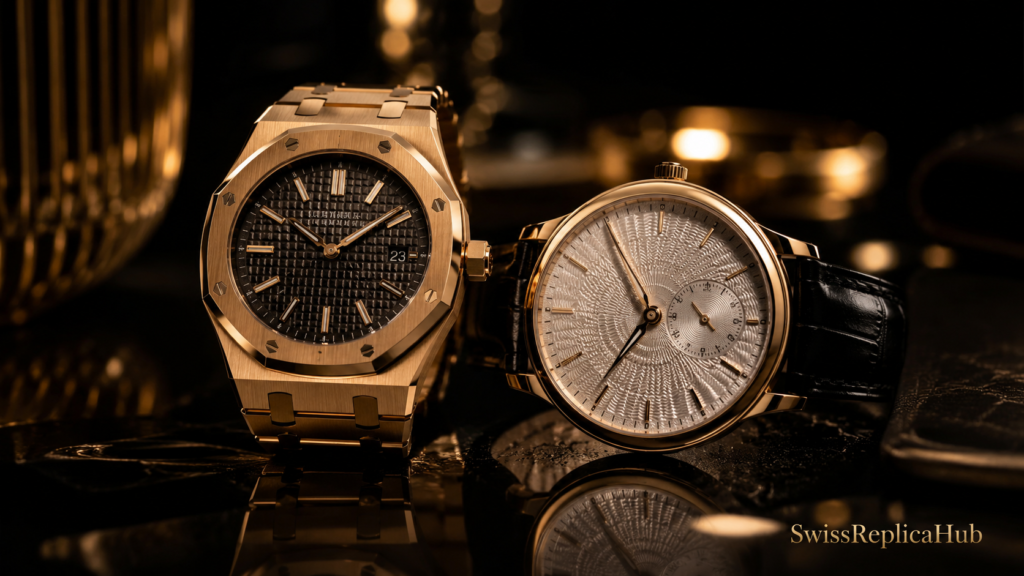
AP vs Patek Philippe: Which Swiss Luxury Watch Brand Deserves Your Wrist?
Introduction
In the rarified world of haute horlogerie, two names stand above almost all others: Audemars Piguet (AP) and Patek Philippe. These Swiss maisons are more than watchmakers — they are institutions, custodians of centuries of tradition, and creators of mechanical art that transcends time itself.
Whether you’re a seasoned collector building a curated portfolio, a first-time luxury buyer making a once-in-a-lifetime investment, or simply a passionate enthusiast who appreciates fine craftsmanship, the question almost inevitably arises: AP or Patek Philippe?
It’s one of the most debated questions in the watch world, and for good reason. Both brands occupy the absolute pinnacle of Swiss watchmaking. Both command extraordinary prices. Both have produced icons that define entire eras. But they are not the same — and understanding their differences could save you from making a very expensive mistake.
In this comprehensive comparison, we explore the heritage, design philosophy, movement mastery, investment potential, and iconic collections of both brands to help you make an informed, confident decision.
Brand Heritage and History
Audemars Piguet: The Rebellious Artisan
Founded in 1875 in Le Brassus, in the Vallée de Joux — the spiritual heartland of Swiss fine watchmaking — Audemars Piguet was established by Jules-Louis Audemars and Edward-Auguste Piguet. From its very first days, the brand was defined by an appetite for the extraordinary.
AP was among the earliest manufacturers to produce ultra-complicated pocket watches, creating repeaters, perpetual calendars, and minute repeater wristwatches decades before most competitors. But the true revolution came in 1972, when Gerald Genta sketched an idea that would change watchmaking forever: the Royal Oak — a luxury sports watch in stainless steel, with an octagonal bezel, exposed screws, and an integrated bracelet. Priced higher than gold watches of its day, the Royal Oak was audacious, polarizing, and ultimately revolutionary.
Today, AP remains independently owned — a rare distinction in an industry dominated by large conglomerates — and continues to push boundaries from its historic manufacture in Le Brassus.
Patek Philippe: The Establishment Grandmaster
If AP is the rebel, Patek Philippe is the establishment — but in the most magnificent sense of the word. Founded in 1839 by Antoni Patek and Adrien Philippe, the Geneva-based manufacture has an almost unbroken record of horological firacles across nearly two centuries.
Patek Philippe invented the wristwatch keyless winding mechanism, produced the most complicated mechanical watch ever made (the Calibre 89, with 33 complications), and has been worn by royalty, world leaders, and collectors of the highest distinction. The brand famously operates under its own philosophy: “You never actually own a Patek Philippe. You merely look after it for the next generation.”
Unlike many watch brands, Patek Philippe remains under the ownership of the Stern family, which has been the steward since 1932. This continuity of ownership has preserved an obsessive commitment to quality, discretion, and long-term value that very few watchmakers can match.
Design Philosophy: Bold vs. Refined
AP — Architecture and Audacity
Audemars Piguet designs watches for those who want to be seen. The Royal Oak’s integrated bracelet, “Tapisserie” dial pattern, and exposed caseback bolts are unmistakable from across a room. AP has consistently embraced bold materials — forged carbon, ceramic, titanium — and has collaborated with artists and athletes to create some of the most culturally relevant watches in modern history.
The brand’s design language is architectural and assertive. It doesn’t whisper. It declares.
Patek Philippe — Classicism and Restraint
Patek Philippe, by contrast, speaks in a quieter register. Its watches are refined, classically proportioned, and built for those who prefer understatement. The Calatrava is the platonic ideal of a dress watch. The Nautilus (also designed by Genta, interestingly) offers the brand’s sportiest expression — and even it exudes elegance over aggression.
Patek’s dials are often works of miniature art: hand-applied indices, enamel painting, guilloche work, and moon phases rendered with such precision they resemble jewelry more than instruments. It is the choice of the collector who values subtlety.
Key Design Differences at a Glance:
- AP: Bold, sporty, architectural, integrated bracelets, high-visibility dials
- Patek: Classic, restrained, timeless, dress-oriented, refined complications
- AP for: The watch lover who wants presence and personality
- Patek for: The collector who prioritizes heritage, tradition, and artistry
Movement Mastery and Technical Excellence
AP’s In-House Calibres
Audemars Piguet produces its movements entirely in-house at Le Brassus, and the quality is exceptional. The Calibre 3120 — the automatic engine powering the Royal Oak — is widely regarded as one of the finest production movements in the world, featuring a 60-hour power reserve, 22K gold rotor, and finishing that rivals brands charging twice the price.
AP’s complications are extraordinary. Their Royal Oak Concept line has produced tourbillons, flying tourbillons, and minute repeaters that push the boundaries of mechanical possibility. The brand is particularly celebrated for its hand-finishing: beveling, circular Côtes de Genève, polished edges, and alternating matte and polished surfaces.
Patek’s Legendary Calibres
Patek Philippe’s movement department is, by most experts’ assessment, the finest in watchmaking. Every movement is hand-finished according to the Geneva Seal (Poinçon de Genève), but Patek exceeds even that standard with its own internal quality protocols.
The Calibre 240 (ultra-thin automatic), the R TO 27 (chronograph), and the legendary Calibre 89 demonstrate the brand’s command over every complication in the horological lexicon. Finishing on a Patek movement — seen through exhibition casebacks — is almost incomprehensibly detailed, with beveled bridges, polished chamfers, and anglage on components that will never be visible in use.
Movement Verdict: Both brands produce movements of world-class quality. Patek holds a slight edge in traditional hand-finishing prestige; AP counters with bold contemporary complications and in-house innovation.
Iconic Collections Compared
AP Royal Oak vs. Patek Nautilus
This is the matchup that ignites the most passion in collecting circles. Both designed by Gerald Genta, both launched within years of each other, and both now impossibly difficult to obtain at retail.
| Feature | AP Royal Oak | Patek Nautilus |
|---|---|---|
| Year Introduced | 1972 | 1976 |
| Case Material | Stainless Steel (primary) | Stainless Steel (primary) |
| Movement | Calibre 3120 (auto) | Calibre 26-330 S C (auto) |
| Dial | Tapisserie pattern | Horizontal embossed |
| Water Resistance | 50m | 120m |
| Current Retail | ~$25,000–$30,000 | ~$35,000+ |
| Grey Market Premium | 2–3x retail | 2–4x retail |
The Nautilus Ref. 5711 — now discontinued — became perhaps the most coveted watch in the world, with secondary market prices soaring past $100,000. AP’s Royal Oak is similarly elevated, with steel references trading at significant premiums.
Other Notable Collections
Audemars Piguet:
- Royal Oak Offshore — the oversized, sportier sibling introduced in 1993
- Royal Oak Perpetual Calendar — complications integrated into an iconic case
- Code 11.59 — AP’s modern round-case collection, still debated among enthusiasts
Patek Philippe:
- Calatrava — the quintessential dress watch since 1932
- Grand Complications (Ref. 5370, 5208) — among the most technically impressive wristwatches made
- Aquanaut — the Nautilus’s more modern sibling, with rubber strap
Investment Value and Resale Performance
This is where the conversation gets particularly serious for collectors who view watches not just as objects of beauty but as stores of value.
Patek Philippe as an Investment
Patek Philippe has historically been the gold standard for watch investment. The brand deliberately limits production, never discounts, maintains immaculate brand integrity, and its top references — Ref. 2499, 5970, 5711 — hold auction records at Christie’s and Sotheby’s that dwarf virtually every competitor. The Patek Philippe Henry Graves Supercomplication sold for over $24 million at auction in 2014, a record that stood for years.
For serious collectors, Patek is blue-chip.
AP’s Rising Investment Profile
AP has historically been considered slightly below Patek in investment terms, but recent years have dramatically narrowed that gap. The Royal Oak’s cultural cachet — embraced by musicians, athletes, and cultural figures — has driven demand to extraordinary levels. Royal Oak Chronographs, limited editions, and early references now regularly achieve significant premiums at auction.
Investment Summary:
- Patek Philippe: Historically proven, most stable long-term store of value in watchmaking
- Audemars Piguet: Rapidly appreciating, particularly for steel Royal Oak references and limited editions
- Both: Significantly outperform the broad watch market over long periods
Price Points: What Does Each Brand Cost?
Both brands span a wide range, but here are typical entry-level and aspirational prices:
Audemars Piguet:
- Entry-level (Royal Oak 15500): ~$25,000–$30,000 retail
- Mid-range complications: $50,000–$100,000
- Grand complications / limited: $200,000+
Patek Philippe:
- Entry-level (Calatrava 5196): ~$25,000–$30,000 retail
- Nautilus / Aquanaut: $35,000–$50,000+
- Grand Complications: $100,000–$300,000+
- Ultra-rare pieces: Seven figures at auction
Who Should Choose AP vs Patek Philippe?
Choose Audemars Piguet if you:
- Love bold, instantly recognizable design with a contemporary edge
- Appreciate integrated bracelet sports watches
- Want a watch that resonates with pop culture and modern luxury
- Prefer visible complications with architectural appeal
- Are drawn to a brand that took a calculated risk and changed the industry
Choose Patek Philippe if you:
- Value heritage, tradition, and centuries of unbroken horological excellence
- Prefer understated elegance over visual assertiveness
- Are building a collection with long-term investment in mind
- Appreciate the philosophy of multi-generational ownership
- Want the most decorated, finished movements in the world
Conclusion
The AP vs Patek Philippe debate will never have a definitive winner — and that’s precisely what makes it so compelling. These are two of the greatest watchmaking institutions the world has ever produced, each with a philosophy, aesthetic, and legacy that is entirely its own.
Audemars Piguet changed the rules of luxury watchmaking with an audacity that still feels fresh half a century later. It speaks to the bold, the culturally engaged, and those who see a watch as an expression of personality.
Patek Philippe is the quiet titan — the watchmaker whose commitment to craft, heritage, and multi-generational value has never wavered. It speaks to those who collect with patience, discernment, and a view toward posterity.
If you can only have one, ask yourself a single question: Do you want a watch that turns heads across the room, or a watch that earns the deepest respect from those who know exactly what they’re looking at?
Either answer is correct. Both choices are extraordinary.
Ready to explore the world of Swiss horology in greater depth?
Browse our complete collection of luxury watch guides, comparisons, and collector resources at SwissReplicaHub — where passion for fine watchmaking meets expert knowledge. Whether you’re researching your first serious timepiece or deepening an existing collection, our editorial team is here to help.
👉 Explore Our Full Luxury Watch Comparison Library →Frequently Asked Questions(FAQs)
Both sit at the absolute pinnacle of Swiss watchmaking. Patek Philippe is often considered the most prestigious by traditionalists due to its age, heritage, and auction records. AP, however, has arguably greater cultural relevance and brand recognition in contemporary luxury circles.
Patek Philippe has historically demonstrated the strongest long-term value retention, with top references appreciating significantly over decades. AP’s Royal Oak has shown impressive appreciation in recent years, particularly in stainless steel. Both outperform the broader watch market.
The Nautilus combines exceptional movement quality, an iconic design, strictly limited production, and decades of brand prestige. The now-discontinued Ref. 5711 in particular became a cultural phenomenon, with secondary market prices often exceeding $100,000 for a watch retailing around $35,000.
The most accessible entry into AP is typically through pre-owned or vintage pieces, though even these start well above $10,000. New Royal Oak references start around $25,000 at authorized dealers — if you can find one.
Yes. Audemars Piguet applies extensive hand-finishing to both cases and movements, including alternating polished and satin surfaces, beveling, and Côtes de Genève patterns on movement bridges and plates.
For a first high-end purchase, some collectors recommend Patek’s Calatrava as a timeless classic that will never go out of style. For those seeking more contemporary appeal, the Royal Oak is iconic. Both, however, require significant investment and patience with waiting lists.
Yes, both are fully independent manufactures. AP produces its movements entirely at its facilities in Le Brassus; Patek Philippe designs, manufactures, and finishes all its calibres in Geneva, meeting and exceeding the Geneva Seal standard.
Patek Philippe was founded in 1839; Audemars Piguet in 1875. Patek therefore has a 36-year head start and is one of the oldest continuously operating watch manufactures in the world.
Both brands sell exclusively through authorized dealer networks and their own boutiques. There is no official e-commerce purchasing channel. Significant grey market and pre-owned market activity exists through reputable auction houses and specialist dealers.
Yes. Many watch brands offer pieces inspired by the Royal Oak or Nautilus aesthetic at a fraction of the price — brands like TAG Heuer, Tudor, and various independent watchmakers offer integrated bracelet sports watches without six-figure price tags. Research carefully and focus on certified, legitimate dealers.

